


On the 27th of February 1996, a pair of games were released for the Nintendo GameBoy: ポケットモンスター 赤 (Poketto Monsutā: Aka, or ‘Pocket Monsters: Red’) and ポケットモンスター 緑 (Poketto Monsutā: Midori, or ‘Pocket Monsters: Green’). Between these two games and their English counterparts (Pokémon: Red Version and Pokémon: Blue Version, released two years later), over 31 million copies were sold, and a spark was ignited. Pocket Monsters, or Pokémon, is now the largest media franchise in the world by quite some margin — enjoyed by both children and adults all over the world. I, for one, still remember starting up Pokémon: Red Version on a flight to America when I was a kid, and they’ve had their claws hooked into me ever since.

It wasn’t until a couple of years ago that I started to toy with the idea of playing one of these games in another language. I picked up a copy of Pokémon: Gold Version in German on my 3DS, and — I know this sounds silly — I was genuinely taken aback at how different it all was. Now, for the uninitiated, I should explain — as of the latest games (Pokémon Scarlet & Violet), the Pokémon games are currently available in Japanese, English, Spanish, French, German, Italian, Korean, and Chinese (both Simplified and Traditional). For a large portion of these, that means translating the names of all 1,025 Pokémon, but also the hundreds (if not thousands) of different battle moves and in-game items before you can even think about game dialogue and story. It must be a truly enormous undertaking. Not to mention the fact that some of the translations have changed over the years between generations, before they were completely standardised.
For the purposes of this post, though, I wanted to focus on the names of Pokémon themselves — and even then just a small selection. A testament to the love and care that’s gone into translating the series so that people all over the world are able to enjoy it. I should state that the Spanish and Italian versions of the games use the English names of the Pokémon, so they won’t feature here. But without any further ado, let’s go back to the days of Red and Blue (or Red and Green if you’re in Japan), when there were only 150 Pokémon.
You’ve just woken up in your bedroom in Pallett Town in the Kanto Region, and it’s time to go meet Professor Oak and choose your first partner Pokémon. At the beginning of most Pokémon games, you’ll be given a choice between three of what are known as ‘starter Pokémon’; a choice between a Fire type, a Water type, and a Grass type. In these first games these were Bulbasaur, Charmander, and Squirtle. So let’s look at these first, shall we?

Bulbasaur is, at first glance, some sort of reptile (or frog?) with a large bulb or seed growing out of its back. Its Japanese name is フシギダネ, Fushigidane. A combination of 不思議 (ふしぎ/fushigi, meaning ‘mysterious’, ‘wonderful’, ‘curious’, or ‘strange’) and 種 (たね/tane, meaning ‘seed’). It’s also a pun, because 不思議だね? (Fushigidane?) would mean ‘isn’t it strange?’. In French, his name is Bulbizarre — a blending of bulbe (meaning, you guessed it, ’bulb’) and bizarre (meaning… oh, I don’t know why I bother). Charmander is a small lizard with a flame glowing at the end of its tail. A charred salamander, if you will. In Japanese, it’s known as ヒトカゲ, Hitokage. This is a combination of 火 (ひ/hi, meaning ‘fire’ or ‘flame’) and 蜥蜴 (とかげ/tokage, meaning ‘skink’ or ‘lizard’). It’s also a more literal interpretation of 火蜥蜴 (ひとかげ/hitokage, meaning ‘salamander’). In French, its name is Salamèche — a mixture of salamandre (no prizes for guessing what that means) and mèche (’flame’). Squirtle is… well, a squirting turtle. It’s a cute little turtle that shoots water out of its mouth. I really don’t think you’re going to come up with a better name for that than Squirtle. In Japanese, its name is ゼニガメ, Zenigame. Some might say this one is less imaginative, as it’s just the word 銭亀 (ぜにがめ/zenigame, the word for a baby pond turtle). But hey, if it works, it works. In German, it’s somewhat bizarrely called Schiggy — presumably a shortening of the word Schildkröte (literally ‘shield toad’), which means turtle or tortoise.

Perhaps the most recogniseable of all Pokémon is Pikachu. The little yellow mouse with red cheeks that has become symbolic of the entire franchise — its name, being similarly iconic, is the same throughout all translations of the game. In Japanese, it’s spelled ピカチュウ, and is a blending of onomatopoeia. ピカピカ (pika-pika) is a sort of sparkling noise in Japanese, a twinkling. And チュウ (chū) is the sound a mouse makes. I think you’ll agree, Pikachu rolls off the tongue a lot better than Sparklesqueak. Similarly, Pikachu’s evolved form Raichu (ライチュウ) retains its squeak, but the initial part is replaced by 雷 (らい/rai, the Japanese word for thunder).
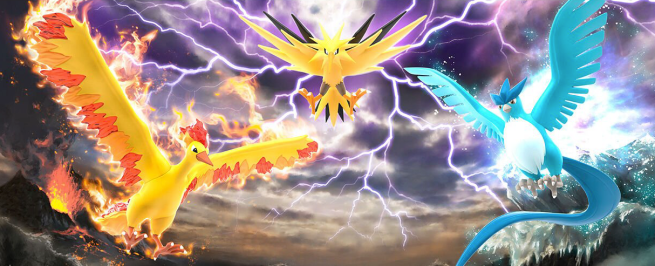
Towards the end of the games, you will encounter three strong flying Pokémon, known as the Legendary Birds: Articuno, Zapdos, and Moltres. In English, their names are suffixed by the Spanish words for one, two, and three: uno, dos, tres. From their names, you’d probably be able to guess that Articuno is an Ice type, Zapdos is an Electric type, and Moltres is a Fire type (though I suppose that last one is a little less obvious if you’re not familiar with the franchise). In Japanese, they’re a bit more… well, basic seems a little harsh, but given these are billed as being some of the most powerful Pokémon in the world, their names do seem a little uninspired; all being English words. Articuno is フリーザー (Furīzā, or Freezer), Zapdos is サンダー (Sandā, or Thunder), and Moltres is ファイヤー (Faiyā, or Fire). I have to say, the translations win this round. In French, the birds are known as Artikodin (a blending of the word arctique, meaning ‘arctic’ and the Norse God Odin), Électhor (a blending of électrique, meaning — shockingly, no pun intended — ‘electric’, and the Norse God Thor) and Sulfura (a blending of sulfureux, meaning ‘sulphurous’, and the Egyptian sun God, Ra. In German, all of the birds’ names end in ‘-os’, as a way of collectivising them — Arktos, Zapdos, and Lavados — no real surprises there.
I think I’ve rambled on for long enough now, but do let me know if you found this interesting — there’s a lot more to cover so I’d love to come back and do a part two, if that would be something any of you would be interested in reading. I haven’t even begun to speculate, for example, why the Electric-type-loving Gym Leader of Vermillion City Lt. Surge is known as マチス (Matisse) in Japanese, or indeed why he turns up in the French and German translations of the game as Major Bob. We’ll have to save that for next time. As for now, thank you very much for reading as always — have you got a favourite Pokémon name fact? Or do you fancy sharing your favourite Pokémon? Feel free to leave a comment below. Alternatively, you can find me on Instagram or Threads (as @sprakskatan), on Mastodon (as @sprakskatan@toot.wales), and now on BlueSky (@sprakskatan.bsky.social), so feel free to get in touch if you see me knocking about the place. Until next time, take care!
— J.
Disclaimer: Pokémon and all associated images, names, and content are the property of their respective owners. Images found here: Professor Oak, Pokémon Scarlet/Violet Language Selection Screen, Kanto Starter Pokémon, Pikachu & Raichu, The Legendary Birds.

 den språkliga skatan