


I seem to start all of my blog posts the same way nowadays: with an exclamation at how quickly time seems to be moving. But it’s demonstrably true, we’re hurtling towards the end of the year at breakneck speed. I feel like it was just yesterday I was sitting down to outline my posts for the year, mostly centred around the writing challenge in November, and now it’s here! It’s going by a new name now, I’m just calling it the Multilingual Writing Challenge, but it’s basically the same as it’s always been in all the years I’ve been doing it. But don’t worry if you’re new around here, and have no idea what I’m talking about: I’ll explain.
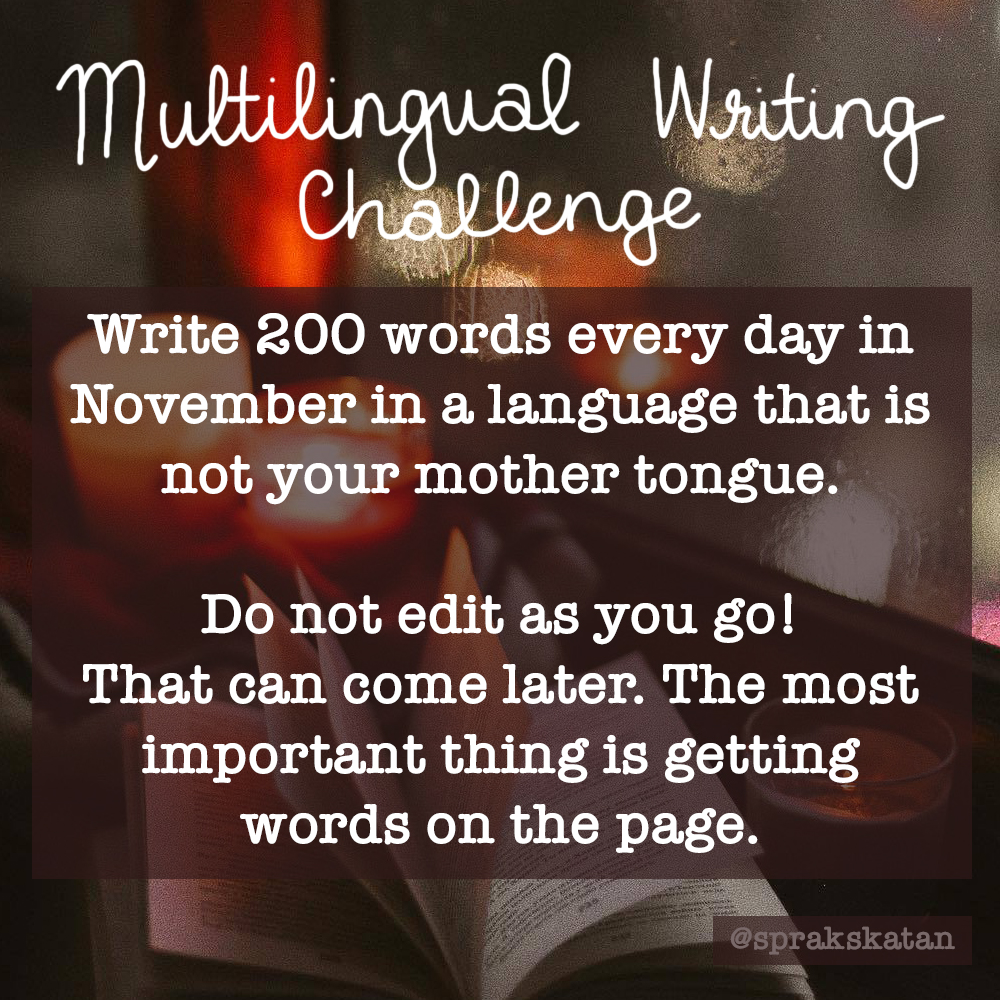
The Multilingual Writing Challenge is a month-long writing challenge in another language, be it one you’re just learning or one you already speak but would like to improve. It can be anything you like! When I’ve done it, I’ve stuck to prose fiction, but I’ve seen people write a daily diary, some have done poetry, there are really no hard and fast rules for the type of content, or even how much. We recommend a daily goal of around 200 words, but if that seems like too much, you could do 100, or even less if you’d like. If you’ll be writing in a language like Japanese or Chinese which doesn’t use spacing between words, you could choose a goal of 400 characters instead — it’s entirely up to you. Just choose a goal that works for you and stick with it. This is meant to encourage the practice of writing regularly, don’t let yourself get bogged down in the logistics of it.
Another very important part of the challenge is that you don’t edit as you go. I, personally, have always been prone to over-editing. I edit myself until there’s nothing left, and then I’ve put in all that work for nothing. The whole point of this challenge is to encourage you to get words down onto the page above all else. Don’t worry about grammar — if you can’t remember the correct form of a verb, write the plain old dictionary form in brackets as a placeholder and come back to it later — as long as you can understand what you were trying to say, you can fix that in December. You might be thinking that the language you want to write in isn’t strong enough for something like this, well, you don’t know until you try. And you never know, you could use an online corpus to see how the word you found in a dictionary is used out in the wild, and it might even cement into your mind that little bit of grammar that’s been eluding you.
All being well, at the end of the month, you should have around 6,000 words (if you’re using the recommended target of 200 words a day). Even if you then decide to go crazy with a red pen (though I think teachers tend to use green these days?) and edit the living hell out of it, you’ll still be left with something that you didn’t have before. You may decide to continue with that project, or throw it in a drawer and never look at it again, but it’s all practice. And who knows, even if you decide you don’t like your work this time around, it might prove to be the building blocks that support a piece of writing you do like.
If you’d like to find other participants, we’ll be using the #MultilingualWritingChallenge on Instagram (and Threads) if I can figure out how that whole thing works. You don’t have to post your work if you don’t want to, but it can be nice to chat, offer support to and be supported by other writers who know what you’re trying to do, even if they don’t see your writing. Why not give it a go? What have you got to lose?

Of course, if you have any burning questions, you’re welcome to ask them here in the comments section. Or of course I can usually be found either Instagram or Threads (as @sprakskatan) or alternatively Mastodon (as @sprakskatan@toot.wales), if you’d like to reach out there instead. And now all that remains to be said is, if you’re taking part, good luck! If you’re not taking part this time, then maybe think about it for next year? As always, thanks for reading my nonsense.
— J.

 den språkliga skatan