


I’d like to talk about something today that I’ve not really gone into for a while. Now, maybe it’s just me, but I still have a lot of guilt attached to watching television – maybe it’s because I sometimes struggle to focus on just one thing, or maybe because it’s always been perceived as a bit of a waste of time; time that I could otherwise be using discovering the cure to some terrible disease, laying gasping for air by the side of a road in vain attempt to run a marathon, or more realistically for me, learning a new language. But that’s ignoring the fact that television series and films are an excellent resource for language learning, so this past month, after finishing Schitt’s Creek for the fourth time and before my fingers naturally drifted to start Gilmore Girls again, I stopped myself.
Now, don’t get me wrong. I’m not one of those strange LinkedIn ‘rise and grind’ robot people who think that all of our time should be productive. You should definitely have downtime, you are absolutely allowed to watch Gilmore Girls for the sixteenth time, eat ice cream and shout at Rory from your sofa as much as you like. But in this moment, I was doing it because it had become almost routine, and not because I actually wanted to – I was bored before I’d even begun. So that’s what spurred me on to try something a little outside my regular rotation of comfort shows, and I tumbled down the rabbit hole and discovered the wonderful world of anime.
Now, I’m not a complete stranger to the concept of anime. I grew up watching episodes of Pokémon, Digimon, and Sailor Moon whenever I could find them – but entirely out of order, so I don’t really know the overarching narrative of any of those shows. I’ve never sat and watched an entire series start to finish, and that’s what I decided I’d do. But which one? That’s the thing about anime – it can seem from the outside that it’s this huge impenetrable monolith with no perceivable access point, but that can’t be true, or nobody would be into it at all. So I scrolled through the selection that Netflix had to offer, and picked one almost at random – I’d heard the name before, even though I knew nothing else about it. And that’s how I came to watch Neon Genesis Evangelion.
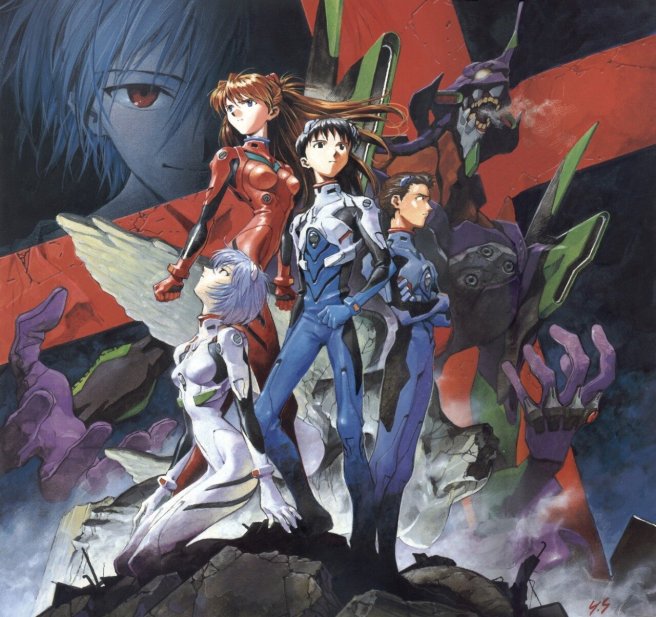
So, let’s start with some basic background information; Neon Genesis Evangelion (original title 新世紀エヴァンゲリオン, or Shinseiki Evangerion) was directed and written by Hideaki Anno (庵野 秀明), produced by GAINAX and animated by Tatsunoko Production (タツノコプロ), and was first broadcast in Japan between October 1995 and March 1996. The story takes place in 2015, fifteen years after a major catastrophe known as the Second Impact, a huge explosion in Antarctica which resulted in a huge rise in sea levels, immediately wiping out two billion people in the Southern Hemisphere. Yet more people died in the subsequent geo-political upheaval and fighting which followed – 500,000 of whom when a nuclear bomb was dropped on Tokyo. A ceasefire is eventually signed and humanity begins to rebuild, but this rebuilding is hindered when a race of enormous, monstrous beings known as ‘angels’ (whose arrival had apparently been foretold in the Dead Sea Scrolls) begin to attack. The angels are virtually indestructible, and to combat them, an international agency named NERV begin building the Evangelion (or Evas) – under the direction of Gendo Ikari – gigantic fighting robots which can, for some reason that either wasn’t explained in the main series or I somehow missed, only be controlled (or piloted) by children. While piloting the Evangelion, the pilot is not just driving the machine, it is hooked up to their central nervous system, and it essentially becomes an extension of their own body that they can actually feel. The story follows Shinji Ikari, Gendo Ikari’s son, who is summoned by his estranged father to the futuristic and newly-built Tokyo-3 with, unbeknownst to him, the express purpose of becoming the pilot of an Evangelion unit, EVA-01, to join the existing test unit, EVA-00. The story follows Shinji’s life as an Eva pilot, still having to go to school and navigate teenagerdom, as well as those of his fellow pilots as they battle the angels who arrive one by one, each posing unique challenges as they evolve in different ways to overcome humanity’s attempts to destroy them.
Now, I have to be honest. If the series had only been about fighting robots, I’m not sure I’d ever have finished it. But hoo, boy. This is going to be as spoiler-free as possible, because I don’t want to lessen the series’ impact if you decide you’d like to watch it itself, but there comes a point in the series where the giant fighting robots are almost incidental. The series is a lot darker than I’d realised it would be, and at times it’s just plain bleak. If the show had been aimed at children, like my other forays into anime were, I’m sure the robots would feature much more heavily. In this, there’s a much greater focus on the pilots, and you’re essentially watching teenagers deal with the trauma of carrying the weight of the world on their shoulders while occasionally feeling like they’re having their arms ripped from their bodies (because they feel everything the Evas ‘feel’). It’s a lot. There are also a few deeply uncomfortable scenes of a sexual nature (involving the adults in the show) that a friend of mine summed up as ‘hikikomori fanservice’; I don’t know if this is a standard thing in anime series like this, but I have to admit, I didn’t enjoy it much.
So, I’d suggest that an alternate title for this series could be ‘Trauma! Now with added robots’, which might let people know what they’re in for before they start. But overall, would I recommend this series? Absolutely. It’s just so different to anything else I’ve ever watched, and it’s strange to see all of this Christian and Jewish imagery being used in a series like this. When the team behind the show were asked, they basically said it was included not to be meaningful or to provide any sort of hidden message, it was more that it would be considered more ‘exotic’ to a Japanese audience, which I can absolutely respect. Also, the theme song, 残酷な天使のテーゼ (‘The Cruel Angel’s Thesis’) by Yōko Takahashi (高橋 洋子) is an absolute 90s banger that you can’t help but tap your toes to. But most importantly, has this experience inspired me to watch more anime? Again, absolutely. Do I know what I’ll be watching next? Not even a little bit, so recommendations are welcome!
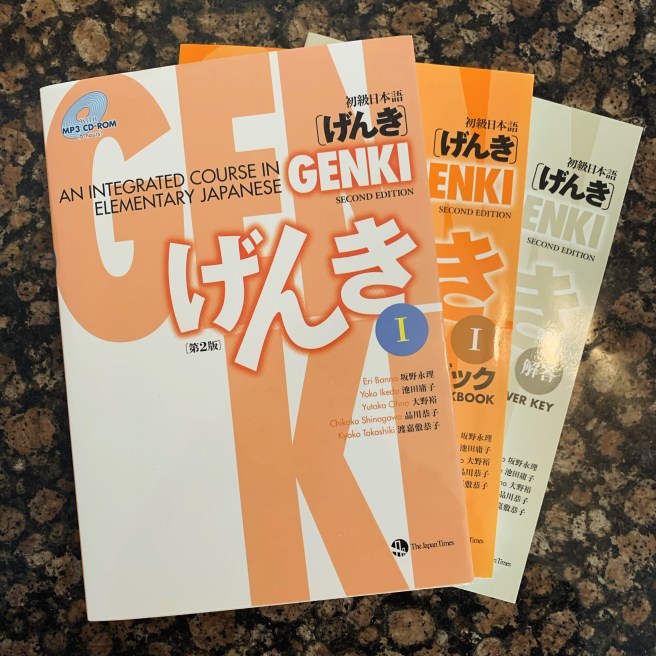
But before we move on, I’d like to go back to the beginning of this post. Television and film can be a great resource for language learning. Why was that relevant to this, I hear you cry? Well, because I enjoyed this series so much, I’m officially learning Japanese again. Surprise! I’ve dusted off my old Genki textbooks (I know there’s a newer edition of these out now, but they were expensive and I’m sure the Japanese language hasn’t changed fundamentally in the past decade, so I think they’re fine) and I’ve been making some notes, slipping phrases into conversation with people who are likely to understand them, and doodling on post-its while waiting for things to load. I’m still focusing on Welsh as my main priority, but I find having two languages going at once works for me because it gives me something to retreat into when I get bored or frustrated with the first one. Who knows, maybe I’ll be taking the JLPT before long? My optimism knows no bounds.
So that’s been my month! If you’d like to get in touch to recommend some anime or for any other reason, feel free, you can find by leaving a comment below, or I can be seen haunting both Instagram and Threads (as @sprakskatan) as well as Mastodon (as @sprakskatan@toot.wales). As always, thanks for reading, and I’ll see you later this month for my traditional Eurovision write-up! Ciao for now!
— J.

 den språkliga skatan